
Seizing the “Golden Moment” of CPTPP: Opening the Door to High-Standard Markets
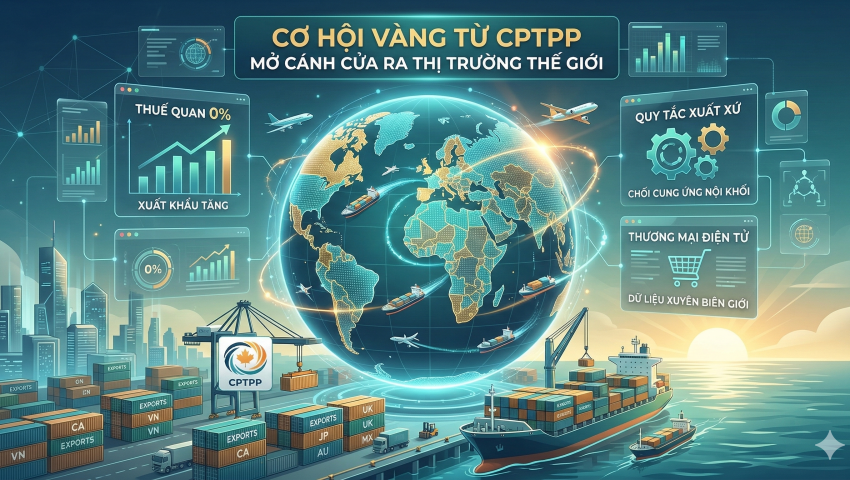
The Comprehensive and Progressive Agreement for Trans-Pacific Partnership (CPTPP) is no longer merely a trade agreement on paper. With the United Kingdom’s official accession and growing interest from several other major economies, CPTPP is transforming into a truly global trade bloc.
This represents a “golden moment” for businesses to proactively seize opportunities—not only to benefit from tariff preferences but also to elevate their position within the global value chain.
1. A “Passport” to High-Standard Markets
The accession of the United Kingdom expands CPTPP beyond the Pacific region, opening access to one of the largest economies in the world with preferential tariffs. For businesses, this creates strategic opportunities to:
Diversify markets:
Reduce dependence on traditional markets that may face geopolitical risks or new trade barriers.
Demonstrate quality:
Meeting CPTPP’s stringent standards effectively serves as a “passport” for businesses to enter other developed markets around the world.
2. Leveraging Regional Cumulation Rules
This is one of the most valuable advantages of CPTPP, yet it is often overlooked by small and medium-sized enterprises.
Optimizing intra-bloc supply chains:
Businesses can import materials from member countries (such as Japan, Australia, or Canada) for production while still qualifying their final products as originating goods eligible for 0% tariffs.
Enhancing competitiveness:
This significantly reduces production costs compared with competitors outside the bloc who still face higher import tariffs.
3. Unlocking New Opportunities: Digital Economy and Services
CPTPP goes beyond physical goods and opens a “blue ocean” for emerging sectors.
E-commerce:
Rules on cross-border data flows and data protection enable technology companies to deploy services across member markets without facing restrictive technical barriers.
Professional services:
The agreement also expands opportunities in sectors such as finance, logistics, and consulting services—areas where digitally transforming businesses can thrive.
Expert Perspective
Businesses should not focus solely on tariff reductions. Instead, CPTPP should be viewed as a strategic lever to modernize production processes and upgrade ESG standards (Environmental, Social, and Governance) to align with the rapidly growing global demand for sustainable and responsible consumption.
Conclusion
CPTPP is entering a new phase of expansion and transformation. Businesses that quickly understand the rules of the game, proactively adjust their production strategies, and increase their technological capabilities will be the ones best positioned to benefit from the shifting flows of global trade.